 770-422-1625
Product Information
The Happy Legs system from Paw Prints in Kennesaw, GA comes in a handsome handcrafted solid wood box that forms the stilts’ base. Each stilt offers a solid support that easily adjusts to fit your dog’s stance. Boxes and stilts come in several sizes to accommodate all dogs.
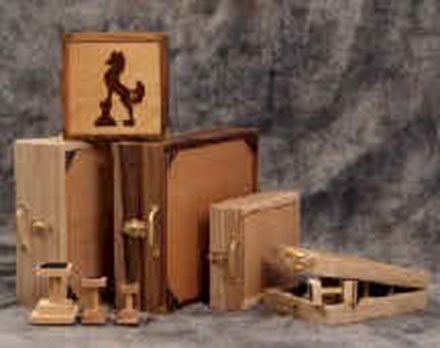 | Box SizesExtra Large Open: 40” x 17” Large Open: 36” x 16” Medium-Large Open (New!): 30” x 13.5” Small Open: 28” x 11” |
Stilt SizesX-Large: 4” Square Large: 3” Square Medium-Large (New!): 3” Square Medium: 2.25” Square Small: 1.75” Square | 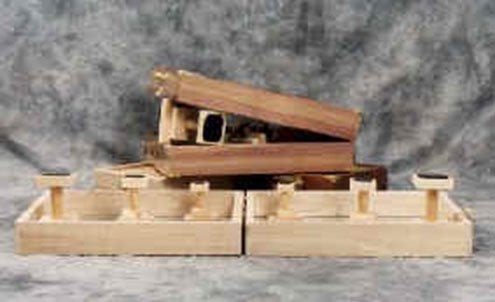 |
Mr. and Mrs. Happy Legs

We were awarded the patent for Happy Legs Stand Stay Stilts in 1997 and what an amazing journey we've been on ever since. Every single stand stay device produced today was created as a result of our very own, original training device, Happy Legs. When they say "imitation is the sincerest form of flattery", they are not wrong! While we're happy that we've been copied soooo many times, there is ONLY ONE HAPPY LEGS STAND STAY STILTS. We have 50 years of dog show experience as breeders, owners, handlers and judges. We've studied thousands of dogs and perfected our product to individual breeds, sizes and stacking options, including creating stilts that accommodate the GSD stack, different sized boxes and stilts to accommodate toy and giant breeds.
Happy Legs has been revolutionizing the way we train dogs for 24 years. From teaching the whoa in hunting to the stand for exam in obedience to the stand stay in conformation, we provide trainers, handlers and owners with the equipment to accomplish this all important task, and showing them it can be taught quickly, without frustration, in a matter of minutes! Happy Legs uniquely isolates each foot with a variety of stilts (sized to fit each dog) in order to PROPERLY teach the young and experienced dog alike, just what it means to hold EACH FOOT still, in a stacked position. Dogs of all ages and breeds learn through positive only reinforcement, while also creating muscle memory for what a comfortable stacked position should feel like.
Bars v Stilts
What is Stilt Training and How Does it Work?
When I invented the concept to teach dogs how to hold their feet still, it came with understanding how dogs learn. Dogs (and people for that matter) learn through positive and negative reinforcement, and positive and negative punishment, among others. In the case of operant conditioning, positive and negative refer to adding or subtracting something. All reinforcement (positive or negative) increases the likelihood of a behavior and all punishment (positive or negative), decreases the likelihood of a behavioral response. Consequences, individual foot placements, and exercising core muscles are all methods that were originally incorporated to teach a proper stand stay.
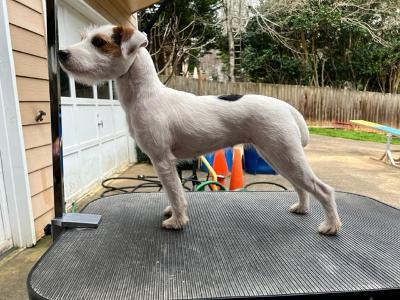 | This is a natural stack on a dog that was taught using the “bar method” from a puppy. You can see how she overloads her front, making her look straight in the front. |
When using any method to train a stand stay for the show ring, you should envision what you want the final picture to look like. Is it a handler* that is constantly manipulating the dog’s stacked position, holding the dog in position, pushing back on a forging dog, or replacing feet on a fidgeting dog? Or, is it a handler that’s barely noticeable, with a dog that stacks itself or when stacked, will stay confident and balanced?
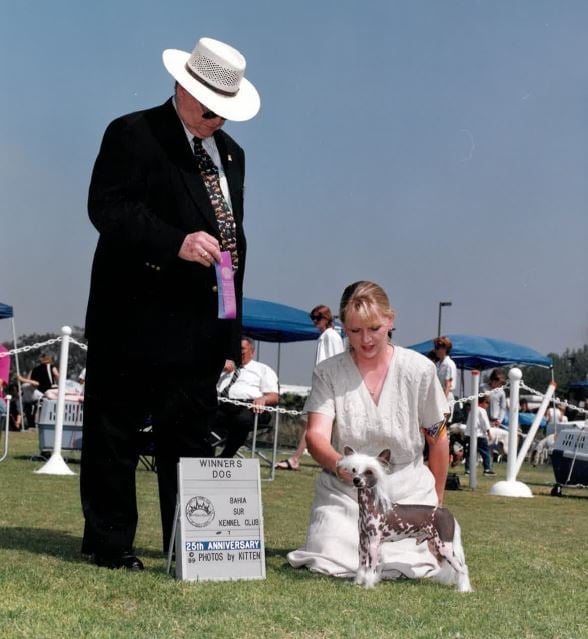 | This is a natural stance that was accomplished using the Happy Legs method. You can see he stand four square evenly balanced. |
This site is under U.S. Copyright laws. Written permission must be given by the author, artist, and web designer before any public use is allowed. For more information about our artwork, design, or text, please contact Mrs. Happy Legs. Permission to link to this site is granted.
